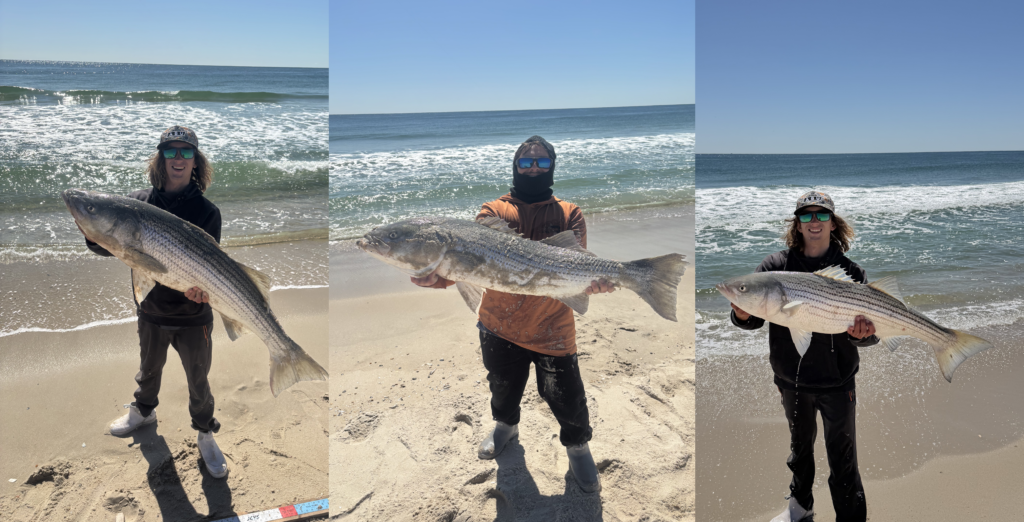
The spring fishery is as good as it gets for surfcasters working the sands of Long Beach Island. The past couple of weeks were great and it keeps on grinding. There’s NOT blitzing fish breaking under birds; however most of the cuts, bowls, toughs and gutters have fish. The spring run is alive on the LBI surf and anglers putting in the time are being rewarded with great catches. Here’s the Long Beach Island Fishing Report Update for Monday May 11, 2026.
Anglers are finding striped bass and black drum on the beaches of LBI both day and night, many times in all of the tide phases and some days in gorgeous and others foul weather. Here’s my latest fishing report video that was published on Friday May 8, 2026.
Last week we have had a lot of firsts…
First week of fluke fishing season! The opening on May 4th and the first week wasn’t lit up with great fluke fishing but we did here some scattered catch reports. Two challenges were chilly ocean water on the incoming current and weedy conditions at many areas. Let’s hope it get’s better.
First bluefish of the season! Store staffer and Van Staal Reel Tech caught a toothy yellow eye chunking off the surf. After sharing Frankies catch a few other bluefish reports have come in. Usually around Mother’s Day we see some. Maybe a bunch! Happy belated Mother’s Day to all of the moms!
First sheepshead of the season! Cooper Adams caught a 21″ sheepshead while hunting striped bass and drum on the LBI surf.
First 50# black drum of the season! Jamie Gramley shared a photo that he took of a friend’s catch, a monster surf side black drum.
The LBI surf bite is on! Striped bass are cruising the surf and feeding. Reports are flooding in daily with anglers catching from the north end to the south end. Fresh clam is leading the charge, but anglers are also catching on lures and frozen bunker. We hope to have fresh bunker one of these days. There are also some black drum on the beaches. The water on the surf has warmed up to the 50º mark and it’s currently clean. The second half of April set up for great fishing, but don’t wait! Now’s the time to Go! Go! Go!
The spring surf fishing has officially shifting into a higher gear on Long Beach Island. After a strong run of bayside action over the last couple of weeks, the surf has really turned on over the past three to five days with quality striped bass and some black drum along the beaches. Clean green water, defined sandbars, bowls and cuts, and water temperatures pushing right around 50 degrees are all positive signs that the second half of April is gonna be a good one.
Most of the surf action right now has been on clam and that’s our recommendation for anglers targeting striped bass and black drum off the beach with bait. That said, it hasn’t been easy to come by so salted and frozen are a backup and have caught good recently. There have also been fish caught on frozen bunker. One anglers had multiple fish two days on a row on it. We are trying to get fresh bunker as soon as possible. As far as reports go, they have come in from all over Long Beach Island, north to south and everywhere in between.
Here’s three photos sent in by Jon Kelly this morning (4/21/26) fishing the incoming tide on the south end with clam. He caught a bunch of them up to the mid 40″ range. He has also been catching on most all of his recent outings.
The Long Beach Island Surf Fishing Classic Spring Derby is also underway, adding even more excitement to an already strong stretch of spring fishing.
The bite is not limited to the surf either, as there are still striped bass holding in the bay, rivers and around the inlet, although some inlet water has been dirty on the outgoing tide. Overall though, this is that classic window from around April 20 through Cinco de Mayo when things traditionally start firing on all cylinders, and that’s exactly what is happening now. If you’ve been waiting for the right time to get in on spring striper fishing at LBI, this is it.
Stop by Fisherman’s Headquarters for fresh bait, tackle, and gear, and get in on the action.
A sunny spring is here this week on Long Beach Island and things are warming up fast. With it, the fishing picture is getting better by the day. With a beautiful stretch of weather, sunny skies and slowly rising water temperatures, the early season bite has expanded. Good reports are now coming in daily from customers fishing the bays and rivers for striped bass. One of the expected developments this week is the arrival of black drum. Check out our latest LBI Fishing Report video published today April 14, 2026.
The progression is positive and right on track for mid-April. The second half of the month looks promising with drum rolling in now! John Haugh caught a big black drum on Sunday fishing fresh clams he got from Fish Heads. He reported that the bite came at slack high tide. This fish was caught locally on a backbay sedge. The next couple weeks are prime time drum fishing in the bay with clam. We have fresh surf clam in the shell in stock now! For help getting geared up to target them stop in.
Our expectations are for a better second half of tog season as the waters warm. We hope to see the Barnegat Inlet rocks come alive before the month is over. So far it has been slow. The sand fleas are just now starting to show so that positive on the tog bait side of things.
This month local white perch fishing is an option too!
On the striped bass side of things, the bays and rivers remain the best bet for anglers looking to get into fish. However that may change over the next couple of weeks. Late April is when things usually begin, with the window from around April 20 through Cinco de Mayo often bringing the first real surf side activity worth talking about. The ocean water remains chilly in the mid 40’s but expect that to warm up this week.
Striped bass are being caught on bloodworms, clam and lures.
Now is the time to get geared up, get out there and take advantage of the season as it starts to unfolds. Fisherman’s Headquarters in Ship Bottom is ready with bait, tackle and expert assistance, just like every year since 1962.
Spring is officially underway and while the Long Beach Island surf remains quiet, the bays and rivers offer good striped bass action. After the full moon and warming trend more fish are showing up adding to the resident population but the recent cold snap will keep things suppresses but not for long. Here’s my lastest fishing report video published on Thursday afternoon, April 9, 2026.
LBI Surf Conditions
Right now a light easterly wind and small 1–2 foot swell are keeping ocean conditions clean but cold. Expect 3-4′ ESE swell on the beaches this weekend. With the surf temperature in the low to mid 40s (42-45º) we need a warm up before things start happening. AC ocean temp gauge recorded a swing from 45-48º however that isn’t recorded locally here on LBI. One report from a boater hunting tog today reported 41-43º nearshore on the LBI south end.
The chilly surf temps will hold back the surf bite, but the progression is happening. As soon as we see consistent temps push into that 48–50° range, things should start popping along the beach. Usually that is in the April 20 – May 5 time frame. By Mother’s Day on May 10 expect the surf to have good fishing opportunities with striped bass and possibly black drum and bluefish.
Bays & Rivers Are The Place To Be
In the meantime, the back bays and rivers are the place to be. They have offered up a range of good early season striped bass fishing over the past couple of weeks. And they should continue to do so throughout this month. Most of the striped bass bites are on live bloodworm. However lure bites are to be had. Anglers finding fish in the back bay and west side of the bay.
Water temps in the bay currently range from the mid-50s up to low 60s in some areas, especially during sunny afternoons with the outgoing tide. That warmer water is key and it’s why the bayside continues to outproduce. Certain areas with warmer waters and more active fish have fish coming on lures. It will improve as we slide deeper into April and experience a real warm up… coming soon. Looking ahead, we have some warmer days with the highs in the 80’s and lows above 60. These temps will be warmer inland away from the water and expect cooler, chilly sea breeze days here on the water. Clams will soon come into play, and we’re expecting the arrival of black drum and possibly the first bluefish any day now. Last year the teens of April produced great black drum fishing… Are You Ready?
Tautog Fishing
As for tautog, the bite around Barnegat Inlet has been SLOW. But it usually is the first week or two of April. Due to the cold water temps the fish have been lethargic. Also inactive… green crabs. They aren’t moving and potting so the bait guys are struggling to catch. It’s the same story each April. The sand fleas have not showed locally yet either. So bait has not come easy for us. When sold out of crab, anglers can turn to clam, shrimp and worms as backup options. Typically, the second half of April brings the better half of the one month tog fishing season. So there’s still tog fishing time look forward to, just don’t sleep on it because it will turn on and then the season will be closed.
Reel-ie Busy Here At Fish Heads
In the shop, it’s full-on spring prep mode. We are “reel” busy servicing reels and spooling line. We’re fully stocked with everything you need for striped bass, tog, and the upcoming fluke season. We also have a lot of new items and much more on the way. Stop by seven days a week and our team here will get dialed in to catch more fish this season.
We got beautiful delivery of Salty-C Wood Lures by craftsman Bob Campi. He has been making some great stuff for many years now and really wanted us to stock his stuff. We are stocked to have his proven fish catching lures on out wall for spring.
We got a monster delivery from JYG! They make some really nice fish catching stuff. It’s all tops, but don’t skip over the new 4″ chubby paddle tail which is pre-molded to fit perfectly with their heads. A match made in heavy.
Here’s four of the top fluke teaser hooks for fishing 5-6″ Gulp Grub Curly Tails. Sure the classic baitholder style hooks work but they don’t hold a bait securely. I fell in love with the BKK Motherfluker late last fluke season but I’m also like some of these other new options from Eagle Claw & Mustad. I can’t wait for fluke season!s this year.
How Brutal Was This Past Winter?
PS: I have heard a lot of talk about the brutal winter and the cold temperatures. While I agree this past winter seemed really cold and far too long, the stats don’t agree! Did you know?… As per the Office of the NJ State Climatologist, “With a statewide ranking of 12th warmest, March 2026 is the eight over the past 26 years to rank in the top 15 with records dating back to 1895.”
Spring is officially here and this weekend’s beautiful weather lit the spark. Some anglers had good fishing across the region. From the early season spots along the rivers and sod banks to stretches of the Barnegat Bay, anglers found hungry striped bass and perch. After the long cold winter, it’s game time!
LBI Fishing Report – First Weekend Of Spring
We’re seeing the first real signs of the season’s progression this weekend. Anglers fishing live bloodworms are finding success with hungry striped bass in the backwaters. Most of the action right now is on bait as the waters are cold and the fish are just warming up from their lethargic state. Once the water temps climb a few more degrees, the artificial action may come alive.
Perch fishing has been solid and while winter flounder is on tap (2 fish at 12″) no reports yet.
Water temps are trending in the right direction and the trend is our friend!
Ocean: Low 40° range
Bay: Mid to upper 40° range in some areas
Early Spring Bait & Tactics
Right now, bloodworms are the top bait. Nothing beats large live bloodworms in the early part of the striped bass season They are are expensive so consider using worm balls and or combo some cheaper (and in stock at Fish Heads) green or red worms. A worm ball’s mesh can help protect the pricey and delicate baits from feisty perch.
Store staffer Emmet is into fish the past couple of days. He reported other anglers near by are catching. He also got a couple big perch on his Top Notch Tackle Bass Worming Rig.
Fish small 2/0-4/0 circle hooks for striped bass baited with worm
Focus on sod banks, creeks, bridges and mud flats
For Perch – small hook (a spot / kingfish rig works great) baited with bloodworm or grass shrimp. Check out the jars of preserved grass shrimp we have in stock! Also the larger ones will hit small and light lures and jigs.
Upcoming NJ Fishing Seasons & Regulations
Blackfish (Tog): Opens April 1 4 Fish Bag Limit – 15” Minimum Size Now is the time to gear up with tackle and rigs
Summer Flounder (Fluke): Opens May 4 with 3 Fish at 18” (same as last year)
Winter Flounder: Open Now 2 Fish at 12”
Black Sea Bass: Regulations to be finalized at the March 26 fisheries meeting
Upcoming Event
LBI Surf Fishing Spring Derby kicks off April 4th. Sign ups begin later this week. It’s always a great way to enjoy the LBI beaches in spring with some added friendly fishing competition.
It’s Game Time!
If you’re not ready to go, we have you covered. Stop by the shop here in Ship Bottom or check us out online at www.FishermansHeadquarters.com and we’ll get you geared up and into fish. 🎣
Fisheries managers want public comments from anglers on Black Sea Bass. Please submit the 2026 BSB Measures form.Submissions must be received by 11:59 p.m. on March 11, 2026, in order to be considered.
If you care about black sea bass regulations in 2026 and beyond, now is the time to speak up. Take a few minutes and help shape the black sea bass regulations for 2026.
The Atlantic States Marine Fisheries Commission and the Mid Atlantic Fisheries Management Council voted to allow NJ to liberalize black sea bass (BSB) regulations between a projected 15-17% in 2026.
NJDEP Fish & Wildlife and the NJ Marine Fisheries Council are interested in input from the public. The final state measures will be set at the March 26 New Jersey Marine Fisheries Council meeting in Manahawkin.
First things first, my apologies for the radio silence. It’s been over a month since the last update. Time got away from me. The holiday season and some big projects at the shop as well as home and posting updates took the back seat. That said, I’m back to share an update as the winter fishing show season is officially ON! But first, a paragraph on the fishing report.
The fall run really shut down after the first week or so of December. The wicked winds were brutal and the deep cold put a halt on things fast. There were very few fishable windows, but some anglers squeaked in some fishing late fall and early winter fishing. We received a couple good reports; however the majority of tog fishing was poor. With back bay bassin’ closed until March 1 the only other options is white perch in the rivers or making the trek south for tuna (which has been good) on down in the OBX.
As always, Fisherman’s Headquarters will be hitting the winter fishing tackle circuit. Come out and score great savings on fishing gear before spring!
What We’re Bringing to the Shows
If you’ve been to our booths before, you already know the deal:
✅ Wide selection of top catching tackle from the past season
✅ New tackle arrivals and fresh gear for 2026
✅ Overstock & clearance items priced to move
✅ Blowout clothing rack & rod rack
Come early… the good stuff never lasts long.
Upcoming Shows We’ll Be Attending
Mark your calendars, come say hello, and take advantage of some serious winter tackle deals.
January 18, 2026 – Lacey HS Fishing Flea Market
This Sunday is the 16th Annual Lacey Township High School Fishing Flea Market. It is one of the biggest and best fishing flea markets in the Central NJ region. Be sure to check it out and help support the great Lacey High School Fishing Club. Proceeds from the event fund fishing trips and outdoor educational experiences from student members of the Lacey HS Fishing Club.
Doors open: 9 AM – 2 PM
$5 Admission, Children 10 & under are free
Address: 73 Haines St, Lanoka Harbor, NJ 08734
February 7, 2026 – Southern Reg Fishing Flea Market
The annual Southern Regional High School Fishing Club’s Fishing Flea Market is Saturday Feb 7th. There is raffles every half hour and a fishing seminar by Bayside Dave at 10am. The event is a fundraiser that helps offset the SRHS Fishing Club’s fishing trip costs.
Doors open: 8 AM – 2 PM
$4 Admission, Children under 12 are free when accompanied by an adult.
Address: Southern Regional Middle School Cafeteria – 75 Cedar Bridge Rd, Manahawkin, NJ 08050
February 14, 2026 – Surf Day
A Day Dedicated to the Surfcaster – The Jersey Shore Surfcasters annual event Surf Day is the original Surf Day. Don’t be mislead by the pop up impersonators. This is the best long running surf show there is! There’s seminars all day long from the Striper Coast’s top speakers as well as a packed house of plug builders and surf fishing tackle. We have the same booth space, in the main room on the left side as entering. Be on the look out for show specials on surf fishing essentials.
Doors open: 8:30 AM – 4:30 PM
$10 Admission, Veterans $5, Kids 14 & Under are FREE
Address: Brookdale Community College – 765 Newman Springs Rd., Lincroft, NJ 07758
February 25 – March 1, 2026 – AC Boat Show
The Atlantic City Boat Show is the regions largest boat show and we are heading back after a decade plus hiatus. We’ll have a small booth (#454) with the best catching tackle for 2026. We’ll also have show specials for spring outfitting.
On Thursday Feb 26 at 4:30PM I will be giving a Light Tackle Striped Bass Seminar on the proven tackle and techniques I use season in and season out.
For more info on the show: https://www.acboatshow.com/about
Booth #454
Address: Atlantic City Convention Center – 1 Convention Blvd., Atlantic City, NJ 08401
March 13–15, 2026 – NJ Saltwater Expo
The biggest and best Saltwater Fishing show in the East. The Saltwater Fishing Expo is the one can’t miss fishing show of the year! It’s a big show packed with fishing as well as giveaways and seminars. We doubled up our space last year and we’ll be back in the same booth this year with lots of great new fishing tackle from Quantum and Shimano as well as all of the top products of 2025 and the best catchers of 2026.
Booth #401
Address: New Jersey Convention & Expo Center – 97 Sunfield Ave., Edison, NJ 08837
Why It’s Worth Stopping By
The winter fishing shows are something that makes the New Jersey fishing scene special. It’s a great time to meet and network with the fishing community and see new things. Touch and feel out rather than clicking and swiping. The shows are an awesome time to check out new tackle and score pre-season pricing.
No shipping delays
No guessing — see it, touch it, compare it
Ask questions and talk fishing
Score preseason & clearance deals before spring
Whether you’re gearing up for spring striped bass, tackling tuna, reloading your surf bag or just expanding into an new fishery or technique, these fishing shows are where it happens.
Finally a beautiful weekend with some good weather and it provided good fishing. It feels like winter but there’s still some “fall fishing” left in the tank… winter isn’t officially here for a couple more weeks (Dec.21). Here my latest fishing report video from yesterday.
Late Fall Striped Bass
The early stretch of December has been cold and it prematurely shifted things into winter like fishing mode. The surf fishing has been slow and spotty. With the surf temps sitting around 45–46° we don’t expect anything spectacular, but a few striped bass are on tap for those grinding the cuts and pockets with lures like diamond jigs with teaser, sandeel rubbers or paddle tails and straight tails. For the entire fall run, the best striped bass fishing action has been via boat. The past couple of weeks have offered windows of solid striped bass catches north of Barnegat Inlet. Many times the northern fleet/boats were fishing down this way. This past weekend, both Saturday and Sunday played out this way again. Anglers working top water spooks, soft-bait paddle tails (NLBN Baits & Tsunami Shads) or those not looking to cast under the birds… troll 9er Umbrella Rigs for sure strikes.
Happy striped bass anglers fishing aboard Reel Fantasea Fishing Charters with Captain Steve Purul.
Wreckin’ Tog
On the wreck side of things… the tautog bite was stellar this weekend with some standout catches from local anglers fishing the wrecks and reef sites. Expect it to be good into the new year. John Ginsberg caught a monster, a 22.8# white chin.
Dante from Magictails was aboard and shared this report, “We fished three spots and didn’t have a keeper. At noon and I said to Rich. I have a spot from 3 years ago that l never fished. We are going to hit a home run or we’ll strike out! But it can’t be worse than this! So we took the ride. The first crab I dropped down was inhaled by a 15 plus lb tog! I look over and everyone on the boat is folded over! For me watching FOUR Magictail Fishing Rods folded over made my day! In the 2-1/2 hours of fishing we caught 15 or so fish over 10# and three over 15# and a giant jumbo… 22.8 lber! We released over 20 fish over 7#, keeping some tog and some jumbo sea bass! A day we’ll never forget!!!”
Check out the Magictail Inshore Series Fishing Rods
Jon Ginsburg holding his 22.8# tautog at weigh in.
LBI Surf Fishing Classic
As the 2025 fall run winds down, it’s worth looking back at the Long Beach Island Surf Fishing Classic. Congrats to tournament winner Bill Tyson and to all anglers who participated and scored, including the catch-and-release standouts in the Surf Master division, Gordon Kirk.
This may be one of my final fishing reports of the year, but I’ll try to continue sharing some fishing tackle shop news as well as winter fishing tackle shows – events.
If you need gear or holiday gifts, Fisherman’s Headquarters is open daily with everything you need for the remainder of 2025 and it’s never too early to think ahead for winter fishing travel trips and the 2026 spring season. Thanks to everyone for the support! See you at the shop and at the shows.
Current Hours
Mon-Fri: 7AM to 7PM Saturday: 6AM to 7PM Sunday: 6AM to 6PM
Upcoming Fishing Shows
Jan 18 – Lacey High School Fishing Flea Market Feb 7 – Southern Regional Fishing Flea Market Feb 14 – JSS Surf Day at Brookdale Community College Fed 25 – Mar 1 – Atlantic City Boat Show March 13 – Saltwater Fishing Expo, Edison NJ
Written by Greg Cudnik, charter captain and associate at Fisherman’s Headquarters Bait & Tackle Ship in Ship Bottom, NJ. Fishing reports and local information is provided as a free resource and based on Captain Greg’s on-the-water observations and decades of local fishing experience on the Jersey Shore.
Happy Thanksgiving from all of us at Fish Heads! We give thanks. We give thanks. We give thanks for family, friends, food and fishing!
We are closing today at 1pm but we will be back to our normal hours tomorrow, opening at 6am on Black Friday. On the Black Friday and tackle sales topic… our largest sale of the season is on now… shop and score on the best tackle at the best prices... Gulp, Jigs, Lures, Hooks, Reel, Assorted Tackle, etc…
On the fishing report front, here is our latest fishing report video posted yesterday…
November’s new moon has kicked off the transition into late fall fishing and it’s shaping up to be a great stretch. There are still quality sized striped bass around and as we move deeper into the month, expect more of the small class of fish to mix in. This change has been evident this week.
Epic Week on the Water
This week delivered some of the best fishing of the season. I was out Monday fishing the gale and absolutely crushed them with only three boats out that I saw. It was nonstop action with striped bass of all size classes. We caught fish every way possible: jigging, casting and live bait.
I’m not sure how but, Tuesday was even better! In my book it goes down as a Top 10 Day. It was right up there or better than the two best days last fall which were all out nuclear, November 27th and 30th. Many large Massive schools of bait and waves of hungry striped bass pushed hard and fed for hours, foaming feeds! It was perfectly scheduled for our previously planned Magictail product shoot with owner Dante and cameraman Nate came up from South Carolina. Nate got a real good taste of Jersey striped bass mayhem. I’m hoping many who read this blog were in on the fun. I know I saw lots of friends and familiar faces/boats having a blast.
I’m looking forward to more great fall fishing ahead!
LBI Surf: Spotty But Improving
The LBI surf has produced scattered catches, but things are lining up. The surf temps are in the low 50º’s and there’s plenty of bait along the beach. With the new moon, abundant bait and the fall run’s migration sliding south, the next couple weeks look promising for the surf.
Each morning this week, anglers have picked off fish on artificials. Now is definitely the time to put in the hours.
Store staffer Emmit caught three bass from the LBI surf this morning. “Birds were working way out of reach,” he reported. “I fished a few cuts and got bites on a diamond jig with a teaser.”
Here’s two recent fishing report videos. Be sure to subscribe to the channel for notifications when a fresh post is live.
Written by Greg Cudnik, charter captain and associate at Fisherman’s Headquarters Bait & Tackle Ship in Ship Bottom, NJ. Fishing reports and local information is provided as a free resource and based on Captain Greg’s on-the-water observations and decades of local fishing experience on the Jersey Shore.